
The Medai Threat Score · October 16, 2026 · 7 min read
How do I find out who my real local competitors are?
By Dr. Medai Abadi, founder of Medai Digital
Short answer
Search the way your customers do, across many specific local searches, and count which local businesses keep appearing. Ignore directories and national marketplaces. The businesses that show up most often, in both Google Maps and the regular results, are your real competition. The Medai Threat Score turns that idea into a ranked list we use to plan where a client can win.
Key takeaways
- Authority scores favor national giants and say little about local markets.
- Presence across many specific local searches shows who really wins customers.
- Precise searches with low volume often bring the buyers most ready to act.
- Local leaders appear in both the map results and the regular results.
- You can run a simple version yourself with twenty searches and a tally.
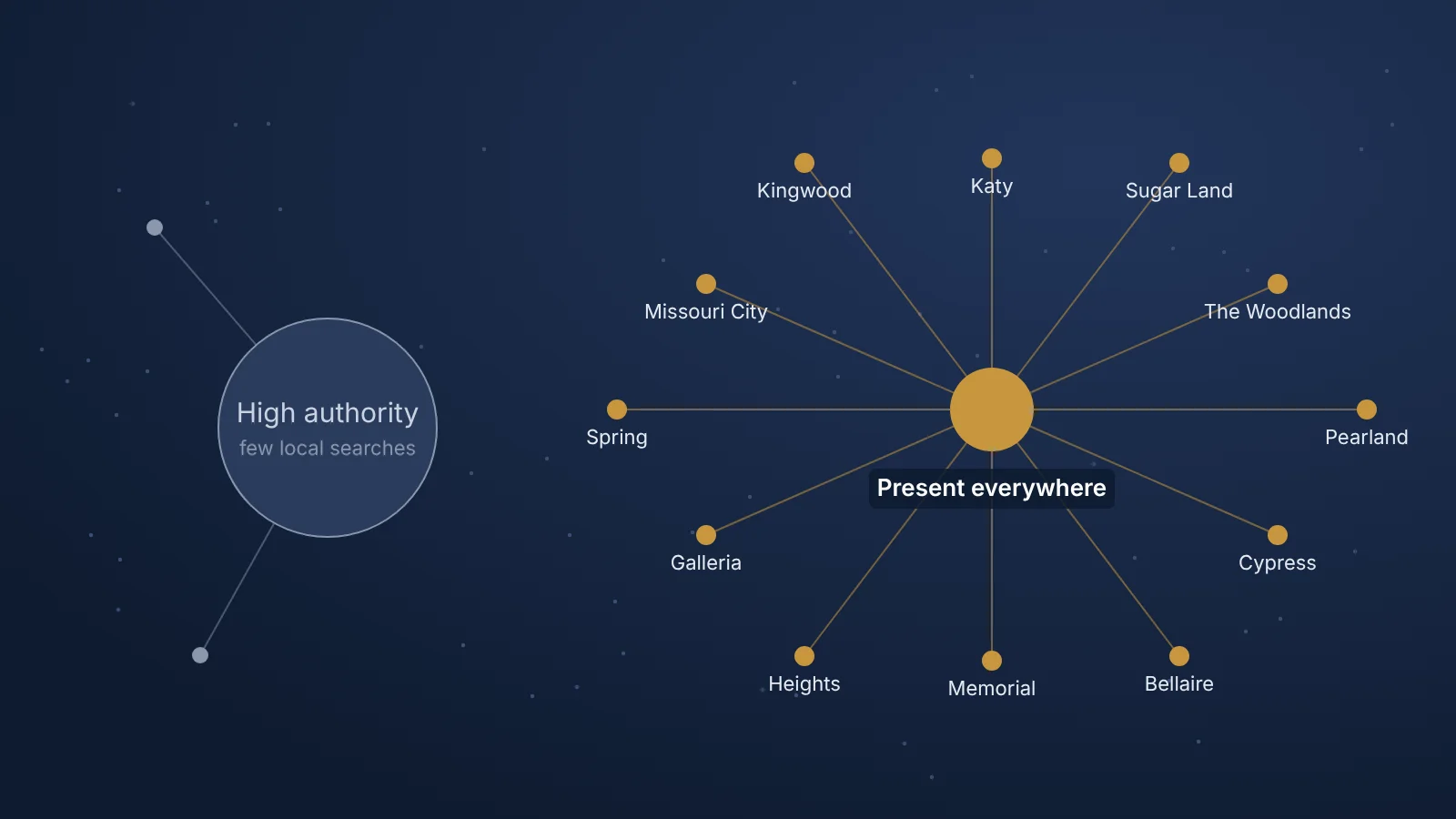
My PhD at the University of Houston was in complex network dynamics. One of the first things you learn about networks is that influence rarely belongs to the biggest node. It belongs to the node that is connected to everything around it: the one you keep running into, wherever you start.
Years later, sorting through thousands of Google search results for a Houston family that manufactures and installs windows and doors, I saw the same pattern. The businesses winning customers were not the ones with the biggest websites or the strongest backlink profiles. They were the ones that kept appearing, search after search, city after city. That observation became the Medai Threat Score.
Why didn't the usual SEO numbers explain the market?
Most competitor research starts with an authority score: a 0 to 100 number, offered by every major SEO tool, that estimates a website's ranking power from the links pointing to it. On that scale, national brands, big box stores and directories sit near the top, and a local company sits near the bottom. If you believe the number, a local business can never win.
But that is not what we found when we searched the way Houston homeowners do. For specific, high value searches, page one was full of local companies with modest scores. One small local company with a very low authority score ranked at the top for exact product searches like a particular size of sliding patio door, because it had a dedicated page for that exact product and size, and the national sites only had a general category page.
Authority scores are built for broad, national questions. Local buying decisions work differently. Google is trying to show the most relevant nearby business for a specific need, and relevance and presence beat raw size.
What is the Medai Threat Score?
The Medai Threat Score is an index of who really holds attention in one specific local market. We built it from the search results themselves:
- Collect the market. We pull the first page of results for hundreds of searches real customers make: services, products, sizes, cities and suburbs.
- Remove the noise. National directories and marketplaces are filtered out, because no one is competing with a directory for a customer's trust.
- Score each local business. The score rewards how often a business appears across all those searches, which we call omnipresence, and how much of the traffic it actually captures. Authority still counts, but only lightly.
The result is a short, ranked list of the local businesses that actually compete for your customers, and how strongly. We share the method openly. The exact weights stay in-house, the same way any firm protects its working tools.
What did it show us about Houston?
Three things, and they surprised even us.
- The strongest competitor was not the biggest. The local business with the highest score had only a moderate authority score. It led because it had built pages for the places Houston buyers actually live, like Katy, Sugar Land and The Woodlands, and it appeared everywhere a homeowner looked.
- Precision beats volume. A search typed only ten times a month for an exact product and size can be worth more than a broad search typed a thousand times, because every one of those ten people is ready to buy. Most marketers ignore these searches. The leaders did not.
- Many searches have two kinds of results. For searches like "patio doors Houston", Google shows a map pack of local businesses and regular results below it. The businesses with the highest scores showed up in both, with a strong Google Business Profile and a strong page on their own site.
How do we use the score for clients?
The score is not a vanity number. It is a planning tool.
- It tells us who to study. Instead of hundreds of websites, we focus on the few competitors that matter, and we look at what they actually do well: which pages rank, which places they cover, how they describe their services.
- It shows where a client can win. The gaps are usually specific: a product, a size, a suburb, a practice area or a county that no strong competitor covers well. That is where we build first.
- It keeps the budget honest. We do not spend a client's money trying to outrank national giants on broad words. We put it where a local business can realistically lead.
- It measures progress. We run the score again over time. If the client's score rises and the leaders' gap narrows, the strategy is working, regardless of what any single ranking does on a given day.
We have used the same method beyond windows and doors. For a Houston criminal defense practice, it showed which firms appear across charge types and counties, and where clear, specific pages could compete without chasing the most expensive general searches.
How is this different from a normal SEO competitor report?
Most competitor reports list the domains with the highest authority or the most keywords nationally. That mixes in directories, marketplaces and national brands your customers are not really choosing between. The Threat Score starts from the searches your customers make in your area, removes the directories and asks one question: who keeps showing up? It produces a short list you can act on instead of a long list you can only read.
Can a small business really beat national brands in local search?
On broad words, rarely. On specific, local searches, often. National sites tend to have one general page for a whole category. A local business can have a clear page for each product, service, size, city or practice area it actually serves, a complete Google Business Profile and genuine local reviews. That combination is exactly what the highest scoring local businesses in our research had in common.
How can you use this idea for your own business?
You do not need our tools to start thinking this way. Spend one hour on it:
- Write down twenty searches your customers really make: your service plus a city or suburb, a specific product, a specific problem.
- Search each one. Ignore directories and national marketplaces.
- For every local business on page one, put a tally mark next to its name.
- Note who appears in both the map pack and the regular results.
- Open the pages that rank and ask what they answer that yours does not.
The names with the most marks are your real competition. The searches where no one strong appears are your opportunities.
When does a threat score not matter?
When the problem is not visibility. If calls go unanswered, if your website does not say clearly what you do, or if you already have more work than your team can handle, studying competitors will not help much. Fix the foundation first.
The score also measures presence, not quality or honesty. Some businesses rank with tactics we would never use, like bought links or copied content. The goal is to understand the market and serve it better, not to copy every trick that works for a while.
Why does understanding the ecosystem matter?
A local market is an ecosystem, not a ladder. Some competitors are rivals, some are potential partners, and many serve customers you do not want. When you can see the whole map, you stop reacting to whoever happens to be on top of one search, and start building steady presence where your best customers are looking. That is how a local business grows without overspending, and it is the way we think about every market we enter.
If you would like to see your own market through this lens, request a free audit, or read how we approach SEO and AI visibility.
Common questions
- What is the Medai Threat Score?
- An index Medai Digital built to show which local businesses really hold attention in one market. It filters out national directories and rewards how often a business appears across many local searches and how much traffic it captures, with authority counted only lightly.
- Is domain authority useless for local businesses?
- Not useless, but misleading on its own. It is built for broad national searches. In local markets, presence across many specific searches and relevance to the place and the need matter more.
- Do you publish the formula?
- We share the method openly. The exact weights stay in-house, and clients see their own market results.
- How often should a business check its competition?
- Every few months, or after a major change in your market. Run the same searches each time so the comparison is fair.